

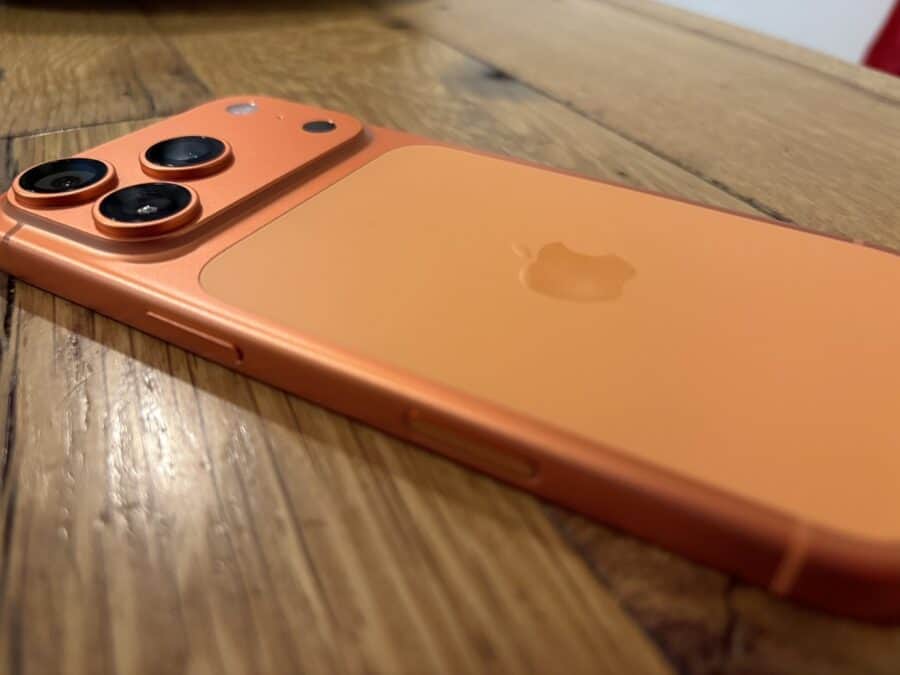
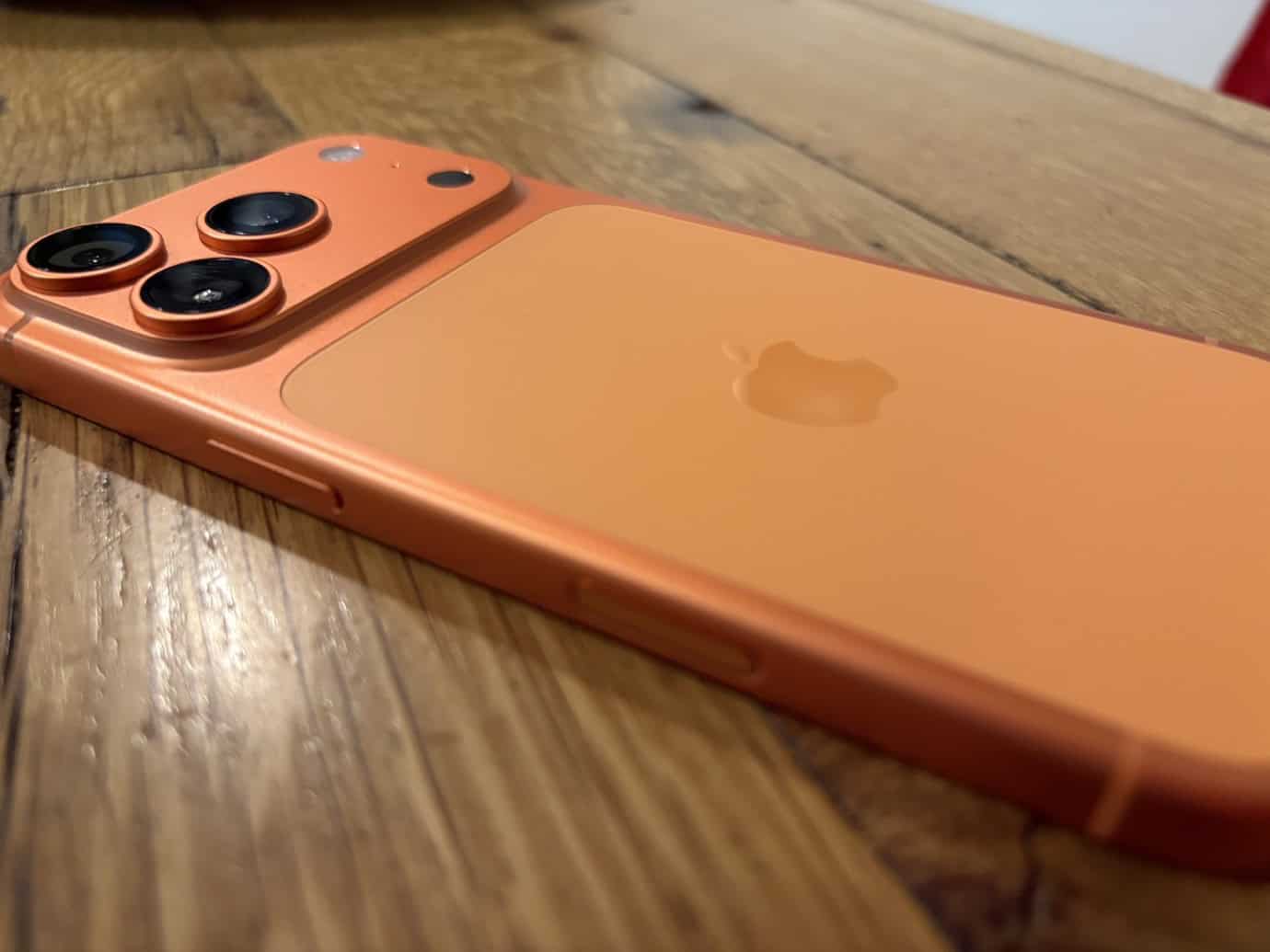
My iPhone is orange.
I mean, really orange. Not “brown but if you hold it in a certain light, it kind of looks orange if you squint.” That in and of itself is a cause for celebration, as it finally brings some much-needed fun to Apple’s pro phone lineup. Pros like color too, you know? And for the ones that don’t there are perfectly respectable options of traditional silver or subdued blue. But the orange phone, well, you can’t forget the orange phone is orange, even when looking at it straight on where the orange frame limns the display with a constant halo.
The iPhone 17 Pro marks the most significant redesign of Apple’s pro phone lineup since its introduction with the 11 Pro. Sure, over time the phone has gotten a little larger, traded out the notch for the dynamic island, and added a few additional buttons. But the 17 Pro’s two-tone back and—sigh—iconic plateau make this phone instantly identifiable.
Also, the orange.
The color seems to have been enabled by the change in construction for this model, which eschews the previous titanium frame (first introduced in the iPhone 15 Pro to replace the original pro models’ stainless steel frames) in favor of an aluminum unibody. Along with the phone’s incremental size increase—it’s a fraction of a millimeter bigger in every direction—it also means somewhat more weight: at 7.27 ounces, it’s slightly heavier than its predecessor’s 7.03 oz. But, it should be noted, it’s exactly the same weight as the iPhone 14 Pro, back before the switch to titanium.
To help mitigate that heavier weight, Apple’s also slightly changed the physical shape of the phone. The edges, especially on the back of the case, are more rounded, lacking the sharper delineation between earlier generation’s metal frames and back glass. That glass is not wholly absent here, as it’s a necessity for enabling wireless charging. Apple’s carved out a panel from the rear case and popped in a slab of its Ceramic Shield material1. Interestingly, that material has the side effect of making the Apple logo look practically invisible in some light—speaking of things you have to squint to see.
There’s been some of the usual foofaraw around whether the phone scratches more easily than its predecessor, and I’ve seen comments from acquaintances who’ve nicked theirs already. After more than two weeks, mine has not suffered any ill effects, despite both being dropped more than once and simply existing in a household with a maverick three-year-old. I do, however, tend to keep it in my pocket by itself, or occasionally with my AirPods Pro 2 case. If my previous iPhones are any indication, it will likely acquire some dings and scratches by the time I turn it in next year, though I’m hoping that Ceramic Shield 2 lives up to its promise, as my 16 Pro’s screen had some significant scratches by the end.
The additional space in the design also helps Apple pack in more battery, which the company says can keep the iPhone 17 Pro going for up to 33 hours of video playback (the Pro Max tacks an extra 6 hours onto that). That’s up from just 27 hours of rated life on the 16 Pro, and in my entirely anecdotal experience over the last two weeks, I’ve rarely had my automation for low power mode, which turns on at 40%, kick in. Towards the end of my 16 Pro’s tenure, it was getting down under 20% most days. But a phone’s battery life is always better at the beginning of its lifespan, so it’s hard to judge the effect over the long term.
Better charging support in the 17 Pro also means that you can theoretically charge this phone to 50 percent of capacity in just 20 minutes—though with the caveat that you’ll need a 40W adapter like Apple’s new model. (A MagSafe Charger with a 30W or better adapter will get you to 50 percent in 30 minutes.) I haven’t bothered upgrading my chargers as I rarely am fussed about mid-day charging, but if you need to charge and go, that’s a plus.
All in all, the phone is a pleasure to hold, and—in my opinion—looks great too.2 I’d hoped the addition of the plateau stretching the width of the back would make it less wobbly on a table and while it is somewhat reduced, it hasn’t been eliminated, thanks to the fact that lenses themselves are still raised above the plateau. I’d love to see Apple figure a way to deal with that in the future, but I’ll accept for now that this is just a fact of life in current smartphone design.
Plus, did I mention it’s orange?
Performance art
Apple loves to tout the performance of its Pro phones, and unsurprisingly the 17 Pro is no exception. The A19 Pro is the most powerful chip the company’s ever produced, even if its CPU performance improvements are predictably incremental.
Its GPU fares somewhat better on benchmarks—but how does that translate into real world performance? I admit that I don’t find myself often taxing the graphical capabilities of my iPhone—perhaps I’m simply not pro enough. I did play a few minutes of Assassin’s Creed Mirage, and it looked good enough, if not quite up to par with my PlayStation 5. I caught a few slowdowns and glitches here and there, but nothing that impacted playability.3

Apple also touts its addition of “Neural Accelerators” to the A19 Pro’s GPU cores. The implications of that are still not quite clear; while it should boost some artificial intelligence applications, it’s unclear as to whether it’s the kind of thing that the average user is going to notice. I’ve seen reports that this enables “matrix multiplication” or “matmul” acceleration, which does seem like it has some possible ramifications for AI, but again, it’s a bit above my head.
One other major change aids performance on the 17 Pro: its new cooling system, designed around a vapor chamber, a first for the iPhone. Here’s how Apple describes the tech:
Deionized water is sealed inside the vapor chamber, which is laser-welded into the aluminum chassis to move heat away from the powerful A19 Pro, allowing it to operate at even higher performance levels. The heat is carried into the forged aluminum unibody, where it is distributed evenly through the system, managing power and surface temperatures to deliver incredible performance while remaining comfortable to hold.
That’s a lot of promise, especially as my experiences with the 16 Pro often led it to getting warm enough that I could use it as a heating pad. In my admittedly short time with the 17 Pro, I’ve found it to generally remain cooler. I was impressed during the setup process, which is usually intensive enough to make the phone quite warm, the 17 Pro remained pretty cool to the touch. Since then, I’ve encountered a couple times when it seemed to heat up4, but it hasn’t been nearly as frequent as with the 16 Pro. Even playing Assassin’s Creed, as I mentioned, the phone was only slightly warm, perfectly comfortable in the hands. Apparently that vapor chamber is doing its job!
Tricameral legislature
Like the 16 Pro before it, the iPhone 17 Pro has three rear lenses, which Apple has extrapolated to five different “cameras” in various levels of zoom, ranging from the .5x ultrawide to the 8x telephoto. This is enabled by the fact that all three rear cameras are now 48 megapixel sensors, thus enabling the company to provide different crops that simulate the 2x and 8x zoom levels.

Look, I’m not a camera person. I’m the Joe Average camera user: I like to snap a shot and not worry about settings. I enjoy having different zoom options because it gives me more choice about how to frame something, but I’m generally a “hit it and quit it” person. Does the 17 Pro take very nice pictures? It does! Can I, at a glance, tell the difference between photos taken with it and the 16 Pro or 15 Pro or 14 Pro…not really? This probably says more about my capabilities as a photographer than anything else.